
Operations
RCFC manages and harvests 120,000 hectares of land, approximately 50km north of town. Situated on the east side of Lake Revelstoke, TFL 56 borders between Carnes and Mars Creek and south of the Goldstream River.
Our annual allowable cut is currently set at 90,000m3. The allotment to British Columbia Timber Sales is 11,480m3. The portion that goes to RCFC is 78,520m3. We have voluntarily reduced the harvest to 55,000m3 until we can create a plan for old-growth and caribou habitat reserves. Once that is completed, we can reassess what harvest levels should look like in the future.

TFL 56 in numbers
-
Gross land base: 120,000 ha
-
Forested land: 69,000 ha
-
Inaccessible areas: 38,000 ha
-
Wildlife and biodiversity reserves: 12,000 ha
-
Harvestable land: 19,000 ha
-
Annual Allowable Cut: 90,000 m3/year
-
Allotment to BC Timber Sales: 11,480 m3/year
-
Total timber for profit sales: 78,520 m3/yr
Sustainability

In the past, RCFC harvested 225 hectares/year, mainly by clearcuts and clearcut with reserve. Current planning aims for less than 100 hectares by a variety of methods, plus thinning and selective harvests on another 100 hectares. That is enough to support a forest economy and keep good-paying jobs in Revelstoke.
Since harvesting on the TFL began in the 1960s, approximately 8,800 hectares of the operable land base are younger plantations and forests. As technology advances and we work toward intensive silviculture, the forests can produce more harvestable volume using less area. Where old growth corridors are interrupted, we can use thinning to accelerate the natural process and establish connectivity more quickly.
Commercial Thinning – Progressive Forest Management
Commercial thinning improves the overall health of stands by removing poor-quality or stressed trees, encouraging a better mix of species, and putting more resources into the highest-value residual trees. Typically, this type of forest management occurs when the stands are 40-50 years old.
Selected trees are removed to capture timber that might otherwise die naturally, while giving the strongest trees more space, light, and nutrients to grow bigger and healthier. Timber harvested provides usable fibre to support the local timber supply and bridges the gap until younger forests mature.
RCFC has treated several blocks using different, innovative methods to maximize timber yields and build in climate change resilience.
Read the full stories in Timber Times. Available at select locations in Revelstoke.


Femelschlag – cutting gaps in the forest canopy
Femelschlag is one of these ideas. Femelschlag (German for "gap-felling") creates small, intentional gaps in the forest canopy. From the air, it looks like a checkerboard. The gaps are meant to mimic naturally occurring events such as pockets of disease or trees blown over by high winds.
Low-impact machinery
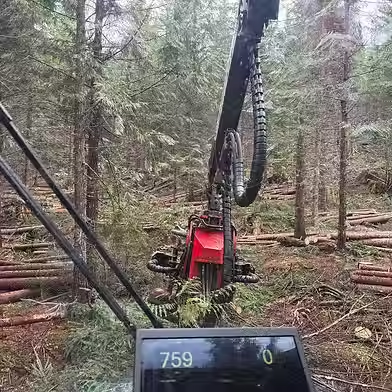
We hired a contractor with a cut-to-length system that uses two machines: a harvester and a forwarder.
The harvester processes trees right where they are standing. It cuts the stem, delimbs it, and sections the trunk into lengths. All branches, bark and debris are left in place, returning nutrients to the soil.
The self-loading forwarder follows. It stacks the wood on its bunk for transport to the landing. Both pieces of equipment are designed to operate in confined areas, reducing their impact on the forest floor and limiting damage to the remaining trees.
Revenues from harvesting go back into the community. We support both large and small projects. More information on where funds are distributed can be found on our Community page.
New Technology: LiDAR
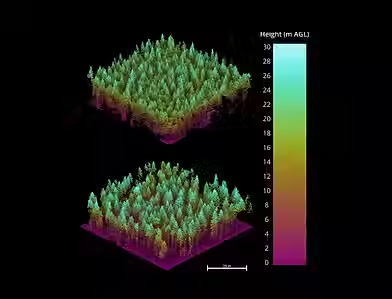
LiDAR (light detection and ranging) is an active remote sensing technology that we use to map prescribed areas by drone or a small plane. Lasers fire down, measuring ground conditions, individual tree height and crowns.
This data produces a colour-coded, three-dimensional map of individual trees, their height and crown size. From this, we can accurately calculate the volume of wood and compare previous readings to evaluate results from commercial thinning.

Log Sort
The creation of a log sort was integral to the purchase of TFL 56. A log sort allows us to control the sales and prices of our wood. In exchange for a percentage of the timber supply, local mills invested in the formation of RCFC. Thanks to the insight and vision of the original advocates, RCFC remains in a unique position among community forest operations.
The log sort is located on Hwy 23N, just before the Revelstoke Dam. RCFC owns the land and operates the weigh scale. Hundreds of thousands of cubic metres of logs have passed through our facility.
Education is key to evolving forest stewardship to new standards. We’re proud of where we are and the work we do to further the RCFC legacy left to us by its founders.

Planning for future forestry
It is important to have stands of trees at different stages across the landscape. Uniformity leaves the forests and us subject to catastrophe. We plan for connectivity, leaving some drainages undisturbed, and protecting old growth where it makes sense.
Anticipation is becoming critical. Our collaboration with university programs and scientists increases our awareness of species migrations and shifts in weather behaviour beyond our landscape. What we observe is only part of larger change.
Bottom line: We work within the belief that our decisions can strike a balance between social, environmental and economic values.